Your Marketing Stack Is a System. Are You Treating It Like One?
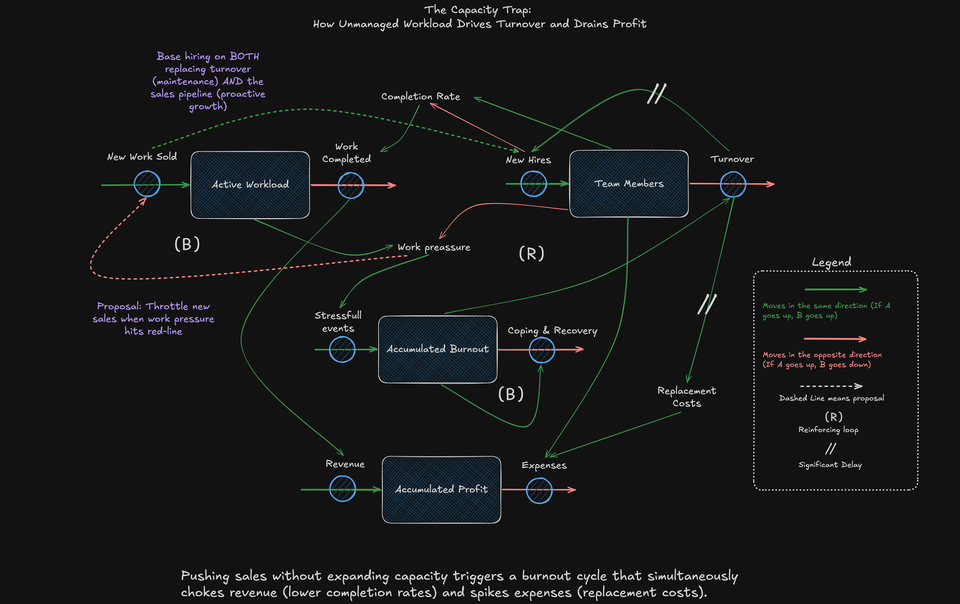
Donella Meadows was a systems scientist. She studied fisheries, epidemics, and the collapse of civilizations, not funnels and campaigns. But reading her book, Thinking in Systems, I couldn't stop thinking her ideas apply to every marketing org I have worked with.
She gave names to the exact dysfunctions we face every day. Here is my attempt at translating her frameworks in the language of marketers.
It's Never About the Tools
Your company says your team exists to drive growth. But if every budget decision is based on last-click attribution, your system's actual purpose is just to fund whatever channel the user happened to click last.
 Javier Cabrera
If attribution models are shaping your system's purpose, it's worth understanding how they actually work.
Meadows calls this the gap between stated goals and revealed purpose: purposes are deduced from behavior, not from rhetoric. Watch what the system produces, not what the pitch deck says.
"If a factory is torn down but the rationality which produced it is left standing, then that rationality will simply produce another factory."
Every system has three ingredients — elements, interconnections, and purpose — listed in order of least to most important. You can swap every player on a football team and it's still a football team. Change the connections or the purpose, and it's a different system entirely.
A lot of our ideas to solve problems start and stop at the elements: the tools. But the problems almost never live there. They live in the connections: the data flows, the handoffs between teams, the way decisions are made.
And nobody audits those.
Stocks and Flows: What the Connections Are Made Of
If the connections are what matter, then stocks and flows are what those connections are made of.
Stocks are accumulated quantities: things you can see, count, or measure.
Flows are the rates at which they change.
Think of a bathtub: the stock is the water level, the flows are the faucet and the drain. You can crank the faucet, but the tub doesn't fill instantly. Stocks take time, and they have inertia:
"Stocks generally change slowly, even when the flows into or out of them change suddenly. Therefore, stocks act as delays or buffers or shock absorbers in systems."
An audience base is a stock. Brand equity is a stock. They all change slowly, even when you turn the faucet up to full blast.
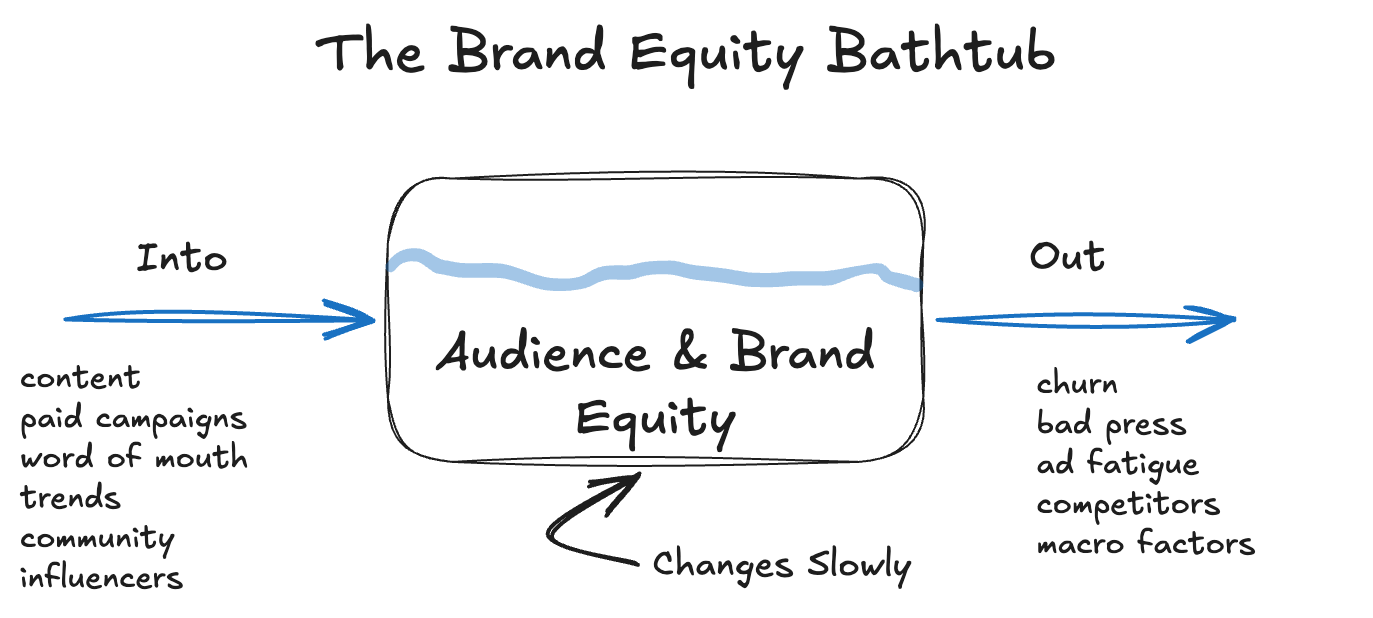
You launch a campaign on Monday. Leads don't flood in Tuesday. Your boss panics by Wednesday. Strategy pivot by Thursday. New creatives by Friday. The system didn't even have time to respond before it got torn apart.
First-party data infrastructure, brand trust, a compounding content engine: none of these compound in a quarter, even with unlimited budget. They fill slowly. They drain slowly too. Brand equity persists even when you stop spending. Organizational dysfunction persists even when you hire new people.
Of course, a marketing system isn't one bathtub. It's dozens of them, connected by pipes.
Brand awareness drains into qualified leads, which drains into pipeline, which drains into revenue, which funds more awareness spend.
One stock's outflow is another stock's inflow. Touch one, and ripples propagate through the whole network, often in ways nobody predicted.
A rough heuristic: flows show up in weekly KPIs (net new subscribers, lead velocity, MQL rate). Stocks show up in quarterly metrics (total engaged database, share of search, brand awareness index). If you're only ever looking at weekly numbers, you're watching flows and ignoring the bathtubs they're filling.
Feedback Loops: What Regulates the Stocks
A feedback loop exists when the level of a stock influences the rate of its own inflows or outflows. The stock changes, which triggers a decision or rule, which changes the flow, which changes the stock. Loop closed.
Two kinds of feedback loops run every system, and between them, they explain most behavior you'll ever see.
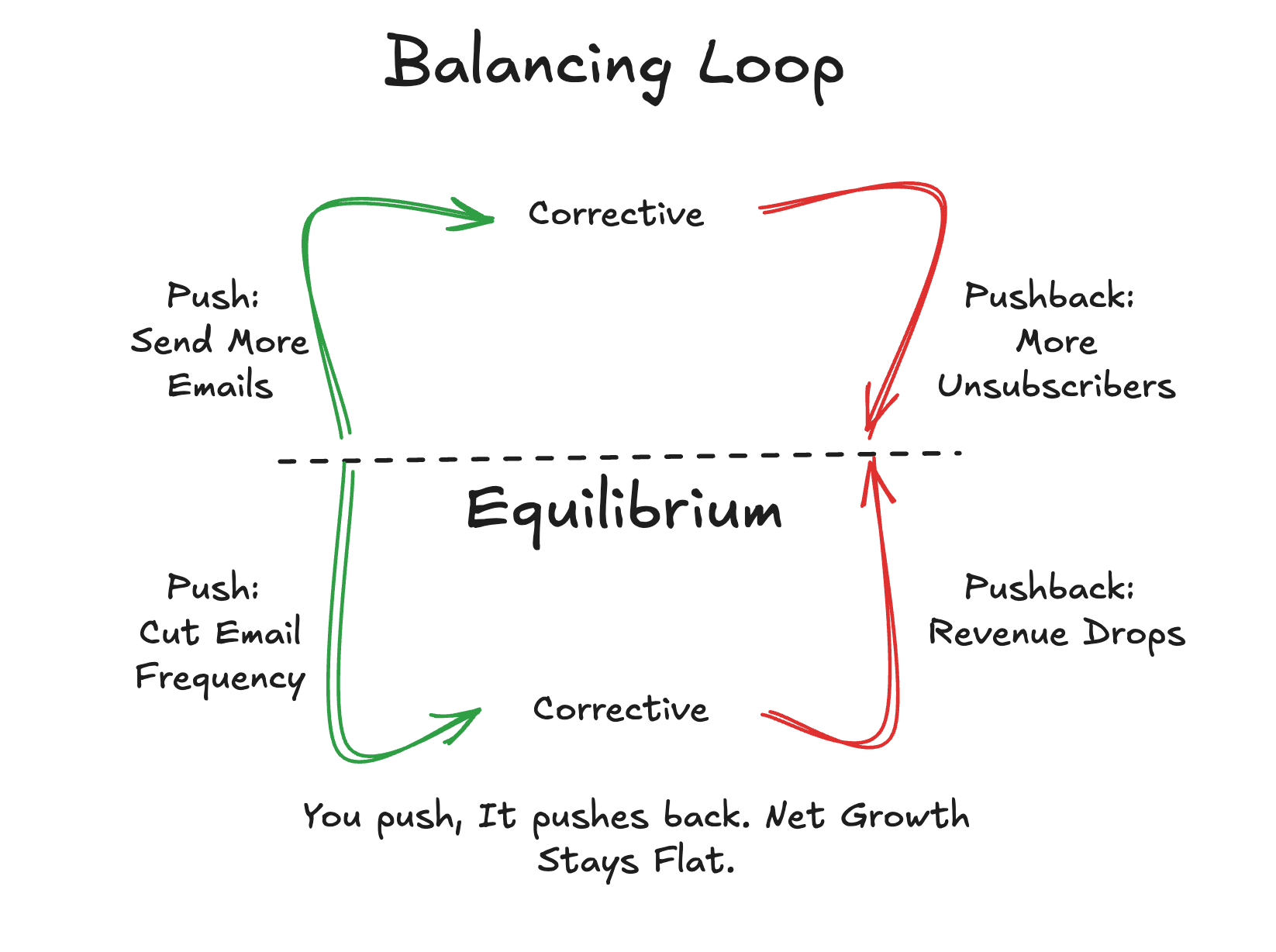
Balancing loops are goal-seeking. They detect a gap between where things are and where they should be, and push the system back toward equilibrium. The way your body sweats to cool your internal temperature down on a hot summer day.
Balancing loops are harder to spot because they look like nothing happening:
You try to grow a channel, it resists. You push harder, it pushes back. Your team increases email frequency to boost revenue; unsubscribes rise to match, net growth stays flat.
That's not a broken tactic. That's a balancing loop doing its job.
Reinforcing loops amplify. They're compound interest, viral growth, and runaway collapses, all the same mechanism. A reinforcing loop doesn't care whether it's virtuous or vicious. It just snowballs whatever's already happening.
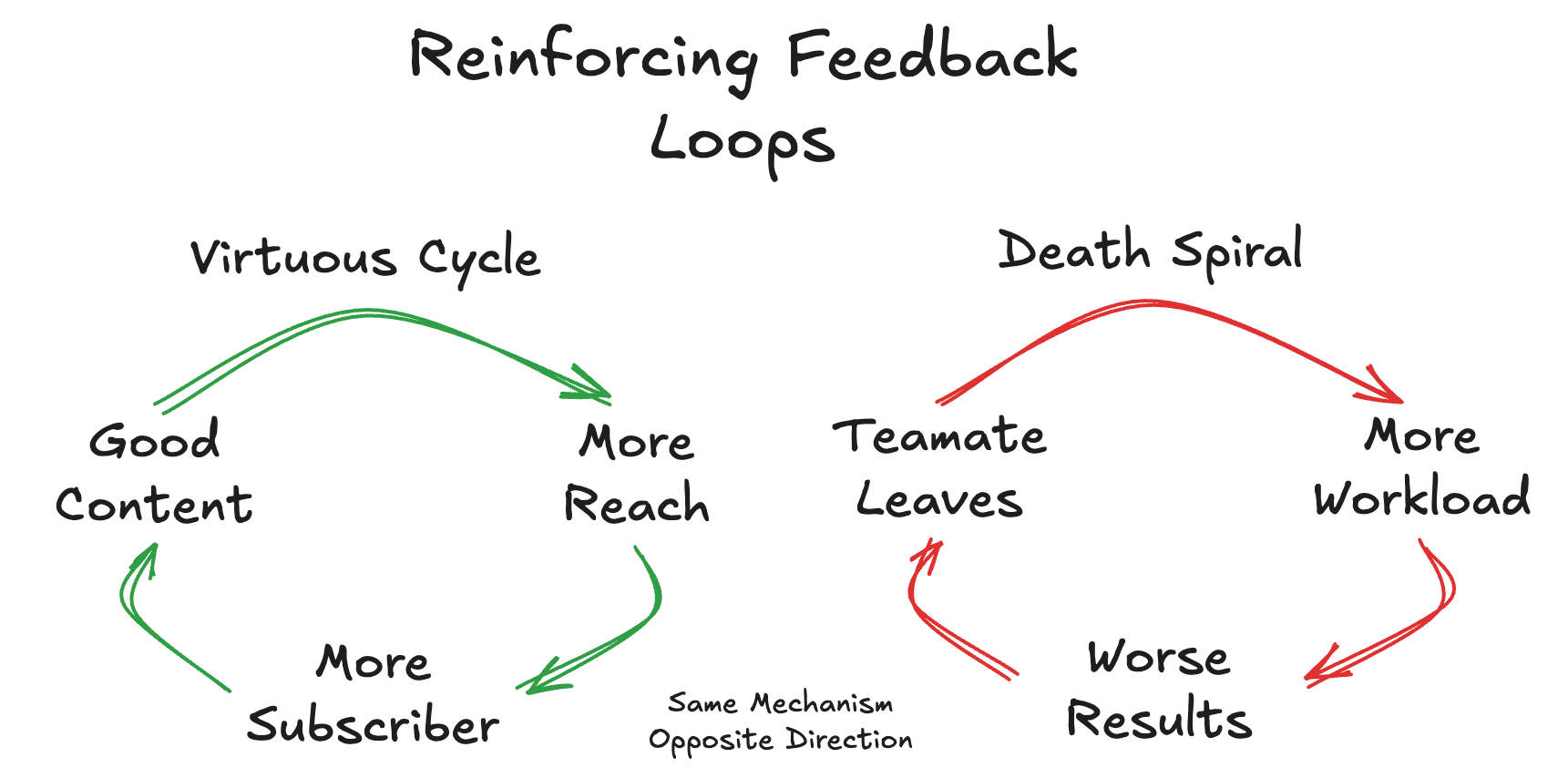
The thing that makes reinforcing loops dangerous is that the mechanism is identical in both directions. The content flywheel and the team death spiral are structurally the same loop — one just has a positive stock change and the other has a negative one. Most teams can't tell which one they're in until it's obvious.
Shifting dominance
Both types of loop tend to be present within a system at the same time. The system's behavior depends on which one is dominant right now.
Early-stage, reinforcing loops do the heavy lifting. The content flywheel is spinning, spend converts efficiently, and it feels like you've found the formula. Then, gradually, balancing loops — saturation, fatigue, org inertia — gain strength. They don't announce themselves. They just make everything work a little less well each month, until the team says "what used to work isn't working" and nobody can explain why.
The instinct is to push the old loop harder. More budget, more content, more headcount. But if a balancing loop is now dominant, pushing the reinforcing one just burns resources against a ceiling. The real move is to identify what's now limiting the system and intervene there — which is exactly what leverage points are, and we'll come back to that.
If you suspect dominance has shifted, three places to look:
- Is drop-off accelerating at a specific funnel stage? That's probably the new bottleneck.
- Are you adding input (budget, content, headcount) without proportional output? You're likely pushing against a balancing ceiling.
- Is the problem volume or conversion rate? Volume weakening suggests the reinforcing loop is losing steam. Conversion dropping suggests something is resisting harder.
Delays: The Reason You Keep Overshooting
Stocks accumulate, and feedback loops regulate them.
In practice, however, feedback loops aren't instant. There's always a lag between an action and its signal, and that lag is where most of the chaos comes from.
"The information delivered by a feedback loop can only affect future behavior; it can't deliver a signal fast enough to correct behavior that drove the current feedback."
When the delay is long, you overshoot. You oscillate.
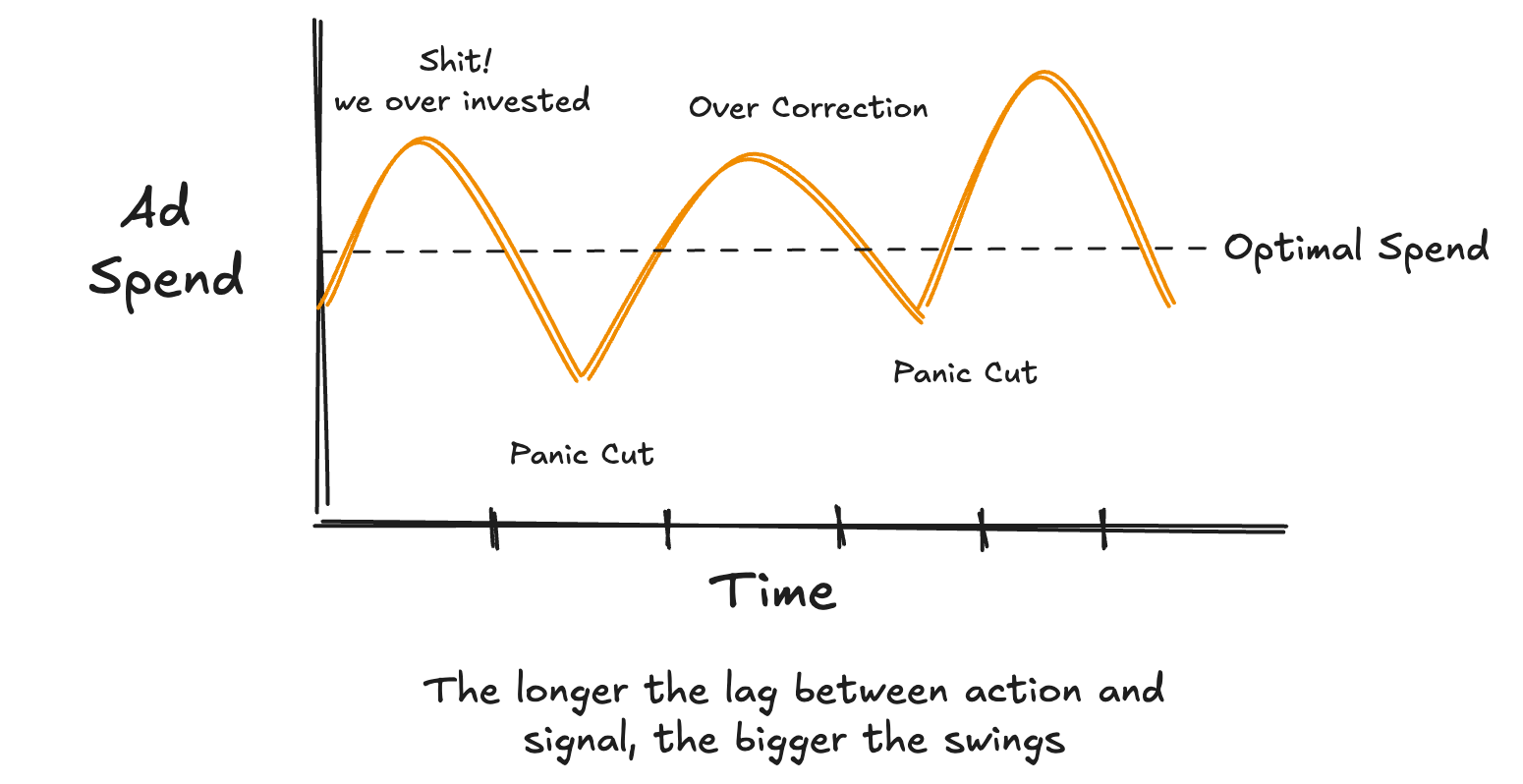
This is the budget cycle at most companies:
Spend goes up, results don't move (because the system hasn't responded yet), someone panics and cuts. Results finally start coming in from the previous spend, but too late — the cut already happened. Next quarter, they over-invest to compensate. Rinse, repeat.
It's also why ad platform algorithms struggle with long B2B sales cycles. Meta and Google optimize toward conversion signals. If your actual conversion takes 90 days, the algorithm is optimizing on whatever happens in the first 7, usually junk clicks or low-intent leads.
The delay between the real signal and the optimization window means the machine is learning the wrong lesson, or not learning at all.
Meadows' rule: when there are long delays in feedback loops, foresight is essential. Acting only when a problem becomes obvious means you've already missed the window.
Why Systems Work So Well
Three properties are baked into every system. They're not good or bad, they're structural. When you work with them, the system absorbs shocks and self-corrects. When you ignore them or accidentally dismantle them (usually in the name of efficiency) things break in ways that are hard to diagnose
Resilience
The ability to take a hit and keep working. You don't notice it until it's gone.
"Just-in-time deliveries have reduced inventory instabilities and brought down costs in many industries. The just-in-time model also has made the production system more vulnerable, however, to perturbations in fuel supply, traffic flow, computer breakdown, labor availability, and other possible glitches."
Because resilience is invisible, it's the first thing people sacrifice when optimizing.
A company builds its entire growth engine on one channel (say, Meta) because that's where the ROAS is best. Then an algorithm update hits and traffic drops 40% overnight. There's no fallback. There was never a reason to build one, because the channel was working.
Diversification looks like waste when things are going well. It's only recognizable as resilience after it's already gone.
For every critical flow: what happens when this breaks?
Self-Organization
Systems can create entirely new structures from the bottom up, without anyone designing them. They create grassroots solutions.
Every marketing org has self-organized solutions: That spreadsheet filling a CRM gap, or the Slack channel coordinating launches? Those aren't governance failures; they’re the system showing you where the official structure has holes.
The useful rule: if your team abandons the official tool for a spreadsheet, don't ban the spreadsheet. Ask what the tool is failing to do — and build that into the official system.
Hierarchy
Systems organize into layers: subsystems within subsystems. Specialist → Channel Manager → VP → CMO.
This structure exists to provide stability. It’s a good thing; you don't want the CMO micromanaging a TikTok ad variation.
But hierarchy acts as a compression algorithm. Every time information moves up a layer, it gets aggregated, simplified, and stripped of nuance.
Here's how this plays out: The paid specialist sees the raw data. CPCs are up 40% and reach is shrinking quarter-over-quarter—classic early signs of audience saturation. But because the average ROAS is still technically hitting the target, the Channel Manager’s weekly roll-up just shows a green checkmark. The VP reports up: "Paid is hitting targets." The CMO sees a slide that says: "Paid is healthy."
By the time the audience saturation is severe enough to break the blended CAC on the CMO's executive dashboard, the window to intervene cheaply has already closed.
The exec isn't stupid. They are just downstream of a hierarchy designed to filter out the exact "noise" they actually needed to hear.
Why Systems Surprise Us
Even when you know the mechanics, systems fool you. Meadows identifies a few recurring reasons
Nonlinearity
The relationship between a flow and its stock isn't a straight line. Double the input does not double the output.
"A little tasteful advertising can awaken interest in a product. A lot of blatant advertising can cause disgust for the product."
The relationship between cause and effect curves, bends, and sometimes flat-out reverses.
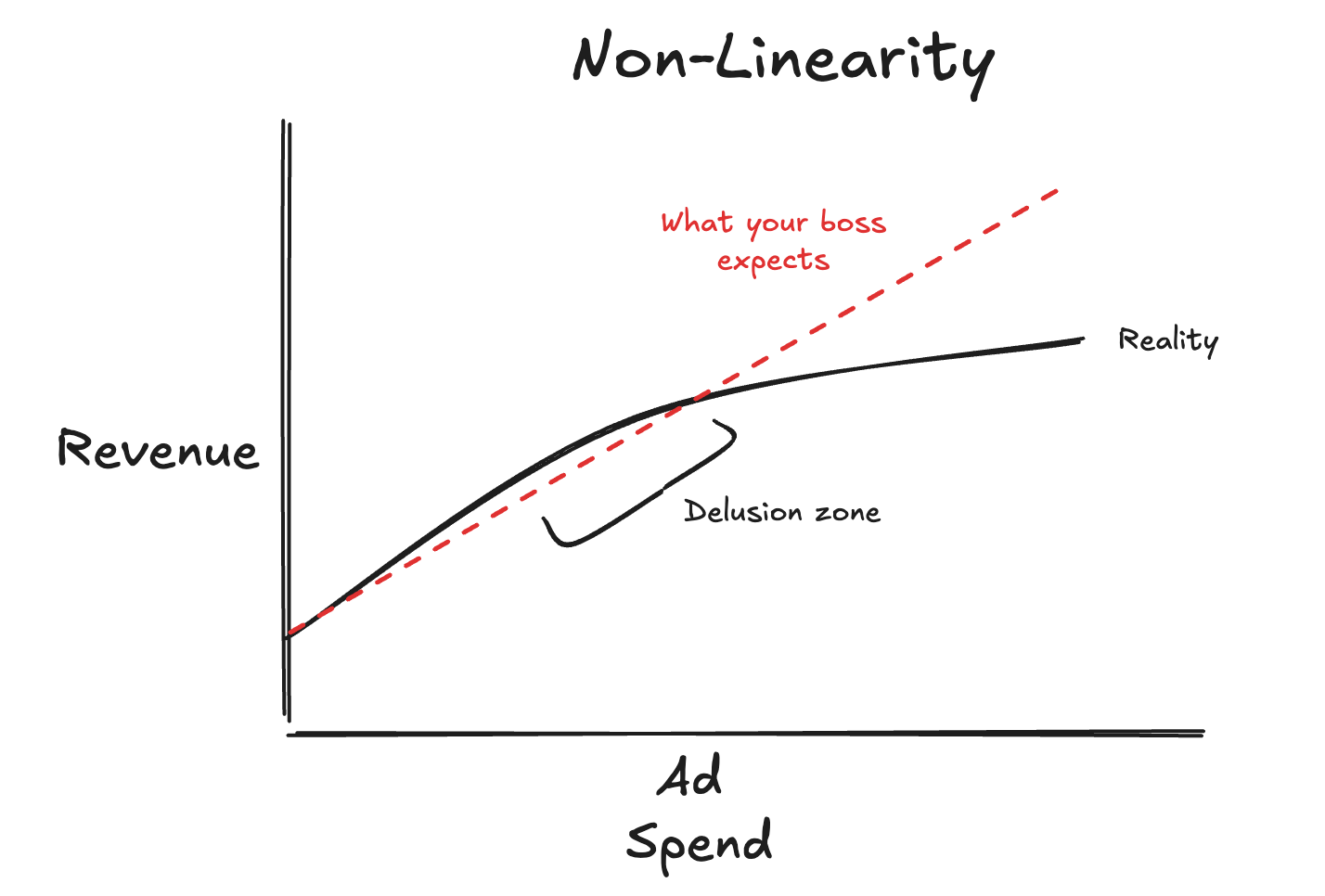
This is why incrementality testing exists.
The first $50k in paid social might generate $5 in revenue per dollar. The next $50k might generate $2. The next $50k? Maybe $0.40 — and you've crossed into territory where you're paying to annoy people. The total ROAS still looks acceptable because the early spend is propping up the average, but the incremental return on each additional dollar is collapsing.
Most marketing measurement assumes linearity: that every dollar contributed equally. Incrementality testing and MMM exist precisely because that's not true. It's an attempt to measure where you actually are on the curve, not where the average says you are. Andrew Chen calls this the Law of Shitty Clickthroughs — performance degrades over time as it saturates.
 Javier Cabrera
If you want to get hands-on with MMM, I wrote a practical walkthrough:
Stop asking about the average return, and start asking: What is the incremental return of the next dollar?
Boundaries
Systems don't come with edges. You have to draw them — and the question you're trying to answer should determine where.
"Why is CAC rising?" is a different system map than "Why are leads dropping?" even though the people involved overlap. The boundary should come from the question, not the org chart. Get the question wrong, and you'll map a system that can't possibly contain the answer.
Bounded Rationality
Every person in a system acts rationally based on what they know. The problem is, nobody knows everything.
"We are not omniscient, rational optimizers. Rather, we are blundering 'satisficers,' attempting to meet (satisfy) our needs well enough (sufficiently) before moving on to the next decision."
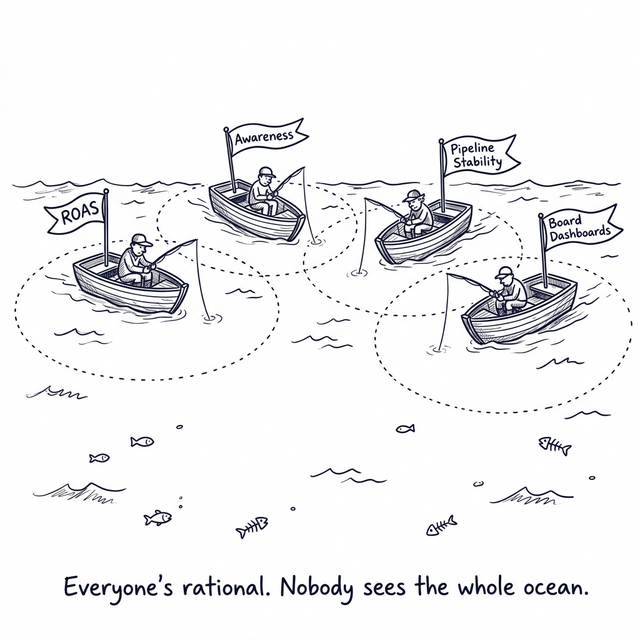
The performance marketing team sees that bottom-funnel search has 5x the ROAS of brand display. Rational move — cut brand display, reallocate to search. Six months later, search ROAS is declining and nobody can explain why. What they couldn't see from their slice of the system: brand display was feeding the top of the funnel that search was converting. They optimized their part and starved the whole.
Every team is a fisherman in its own boat, pulling from the same ocean, seeing only its own catch.
The fix isn't better individual decisions. It's in changing the relationships and information flows within the system.
System Traps (and How to Escape Them)
Meadows identifies recurring patterns — archetypes — that show up across wildly different systems. She calls them traps, but also opportunities: once you recognize the structure, you can change it.
A few that hit close to home:
Policy Resistance
When multiple actors pull a system toward different goals, every effective change triggers resistance from the others. Nobody wins. Everyone exhausts themselves maintaining a status quo nobody actually chose.
Picture a website migration.
- Marketing wants the new site live yesterday — it's blocking a campaign.
- Analytics needs a clean dataLayer implementation before launch, but doesn't want to be the reason the whole project stalls.
- IT wants stability and sees the dataLayer requirements as technical debt that doesn't fit cleanly into their sprint cycles.
Each team has a legitimate goal, and each goal directly conflicts with the others:
- Marketing's speed threatens IT's stability.
- IT's caution blocks Marketing's revenue.
- Analytics' requirements look like scope creep to IT and a delay to Marketing.
Each one's progress triggers resistance from the others. The migration gets delayed, compromised, and eventually launches half-baked because everyone ran out of political capital.
The way out is counterintuitive: stop pulling.
Get all three teams in the same room, align on a shared definition of "done," and redirect the energy from resistance toward a sequence everyone can live with.
Tragedy of the Commons
When a shared resource is erodable and users have no incentive to restrain themselves, you get overgrazing.
The marketing version: every team in your org — performance, lifecycle, partnerships — runs campaigns at the same pool of potential customers. Each touchpoint benefits the individual team. However, the audience gets battered: inbox fatigue, ad blindness, retargeting overload. Brand perception erodes slowly, then suddenly.
Nobody's individual campaign caused the damage. But collectively, the commons is overgrazed.
Three defenses:
- educate (show teams the cross-channel fatigue data),
- privatize (assign distinct audience segments; you own this group, you reap what you sow),
- or regulate (frequency caps, suppression lists, a centralized campaign calendar).
If you've ever opened your own inbox and felt attacked by a brand you once liked, that's what it may look like from the other side.
Escalation
"Advertising companies escalate their bids for the attention of the consumer. One company does something bright and loud and arresting. Its competitor does something louder, bigger, brasher. The first company outdoes that. Advertising becomes ever more present in the environment, more garish, more noisy, more intrusive, until the consumer's senses are dulled to the point at which almost no advertiser's message can penetrate."
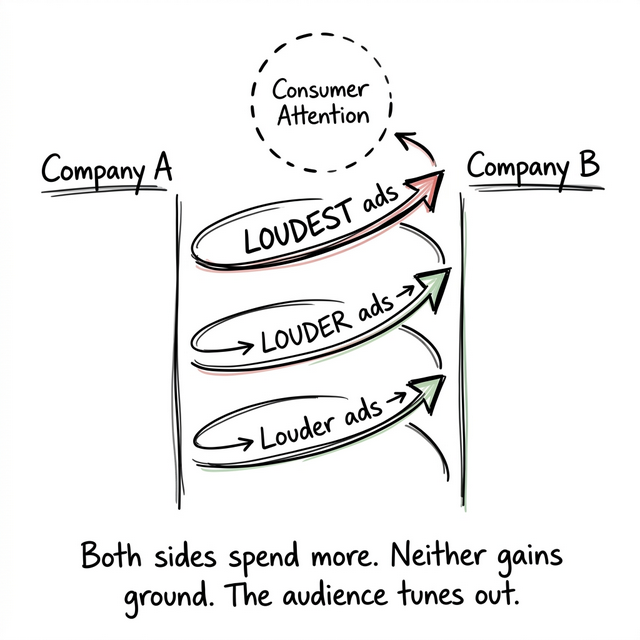
Meadows wrote this decades ago and it reads like a description of my Instagram feed in 2026.
Escalation is a reinforcing loop between competing actors. Each side raises the stakes in response to the other. Price wars, feature wars, ad-spend wars. Both sides spend more to maintain the same relative position while the shared resource (consumer attention) degrades.
Meadows' answer is that someone has to stop. Unilateral de-escalation. In theory, that works. In practice, no CMO is going to cut spend while competitors go louder.
The more realistic escape is refusing to compete on the same ladder.
You don't need to be louder if you're instantly recognizable. You don't need to outbid everyone if you own the channel. Distinctive brand assets, owned audiences, community — these are structural exits from the escalation loop, because they move competition to a dimension where volume doesn't matter.
Addiction (Shifting the Burden)
When a short-term fix becomes a dependency that erodes your ability to solve the real problem, you're in the addiction trap.
Paid spend dependency. Paid acquisition is the fix at the start. It works fast, produces measurable results. But it does nothing to build the organic inflows that would make the system self-sustaining. Over time, the org's ability to grow without paid spend atrophies. Every time the budget gets cut, the entire growth engine stalls, confirming the belief that "we can't grow without spend."
The trap feeds itself: because organic was slow, it was never built. Now paid is always necessary, so organic is never prioritized, so paid remains necessary.
Limits to Growth
A reinforcing loop will always eventually hit a balancing loop that slows it down. The trap is that the obvious response — push the reinforcing loop harder — makes things worse when it's the constraint that needs addressing.
A startup builds a marketing flywheel: good ads drive traffic, traffic drives signups, signups justify more ad investment. A reinforcing loop, compounding nicely. Then at some point, more content stops producing more growth — because the bottleneck has shifted to sales capacity. The leads are there, they're just not being worked. Pushing harder on ads doesn't fix a sales capacity constraint. It produces more leads that don't convert.
The mistake is applying the fix that worked at the last stage to a constraint that has already moved.
Leverage Points: Where to Actually Intervene
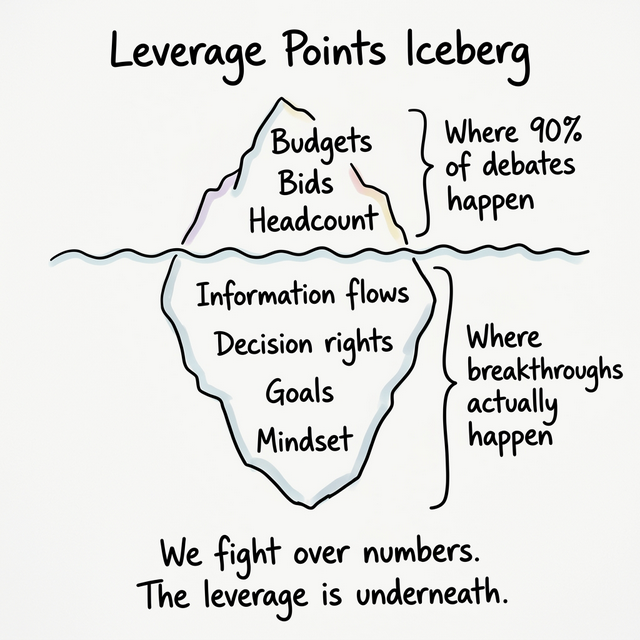
Meadows published a list of 12 places to intervene in a system, ranked from least to most powerful. The defining tragedy of most marketing teams is that we spend all our time fighting over the least effective ones.
The list runs from low leverage (tweaking parameters: adjusting a budget or changing a bid) to high leverage (changing the core goal the system optimizes for, or the mental model that produced the goal in the first place). Each level up produces a proportionally bigger change in system behavior—but also faces proportionally more political resistance.
Here's the list, with the marketing translation:
| # | Leverage Point (Meadows' Term) | What It Means | The Marketing Reality |
|---|---|---|---|
| 12 | Constants, Parameters, Numbers | The mechanical knobs you turn. | Budgets, CPC bids, headcount, frequency caps. |
| 11 | Sizes of Buffers / Stocks | The size of the reservoirs that absorb shocks. | Total addressable market, size of the email list, cash reserves. |
| 10 | Structure of Material Flows | The physical or logical plumbing. | The tech stack architecture; how a lead technically routes from Facebook to the CRM. |
| 9 | Lengths of Delays | The lag between action and feedback. | The length of the sales cycle; the delay in attribution windows. |
| 8 | Strength of Balancing Loops | How hard the system resists change. | Ad fatigue, market saturation, unsubscribe rates pushing back against volume. |
| 7 | Strength of Reinforcing Loops | How fast virtuous/vicious cycles compound. | Content virality, product-led network effects, word-of-mouth referral loops. |
| 6 | Information Flows | Who has access to what data, and when. | Giving the Content team visibility into closed-won revenue, not just pageviews. |
| 5 | Rules of the System | Incentives, constraints, and definitions. | How bonuses are structured; the exact criteria that defines an "MQL." |
| 4 | Power of Self-Organization | The ability for the system to evolve its own structure. | The freedom for a team to abandon a dying channel and build a new one without a 6-month executive review. |
| 3 | Goal of the System | The actual objective the system is optimizing for. | Are we optimizing for pipeline? Top-line revenue? Profitability? Or just "volume of leads"? |
| 2 | Mindset / Paradigm | The deeply held belief from which the system arises. | The belief that "Marketing's job is to buy ads" vs. "Marketing's job is to create demand." |
| 1 | Transcending Paradigms | The ability to abandon a mental model entirely. | A leadership team willing to throw out their entire playbook when the market fundamentally shifts. |
Most marketing debates live safely in the 12–9 range. We spend 90% of our time arguing over budgets, audience sizes, and reporting cadence.
The actual breakthroughs happen at 1–6: changing the information flows, the decision rights, and the core goal the system is chasing. This is why redesigning your attribution model or changing your team's bonus structure matters infinitely more than doubling your ad budget. It's not just a bigger parameter—it completely rewrites what the system optimizes for.
The reason we stay stuck at the bottom of the list isn't ignorance. It's that low-leverage interventions are politically safe. Asking for more budget is easy. Questioning the goal the organization is optimizing for, challenging who controls the source of truth, or telling the executive team their growth paradigm is dead? Those interventions require taking apart something someone owns.
"Folks who do systems analysis have a great reputation for developing answers that are technically correct and either politically impossible or just plain unimplementable."
That's why Meadows' quote lands so hard: technically correct, high-leverage answers are often politically terrifying to implement.
If a problem keeps returning after each fix, you're probably intervening at the wrong level. Ask what would have to change one level higher.
The Cheat Sheet
Most marketing problems look like execution problems, but they are almost always structural. Before you rebuild the stack, fire the agency, or launch another campaign, run a systems check first.
| Systems Concept | Marketing Translation |
|---|---|
| Purpose ≠ stated goals | Watch what the system does, not what the deck says |
| Stocks change slowly | Brand equity and 1P data don't compound in a quarter |
| Feedback loops | Can be reinforcing or balancing. Map them. Know which one dominates right now |
| Shifting dominance | "What used to work" stopped because the structure changed |
| Delays | Feedback loops are not instant and lead to oscillation. Plan for that |
| Nonlinearity | 2x budget ≠ 2x results. Model the curve, not the line |
| Resilience | Efficiency without fallbacks is fragility |
| Bounded rationality | Everyone's optimizing locally. Nobody's optimizing globally |
| Tragedy of the commons | Shared audiences get overgrazed. Regulate or privatize |
| Escalation | Competing louder dulls the audience. Compete differently |
| Addiction | If you can't turn it off without collapsing, it's a dependency |
| Leverage points | Budgets sit at the bottom. Mindset sits at the top |
Next time someone asks you to "fix the marketing"—it's worth asking which part of the system they're actually talking about.
Argue about feedback loops, share your own martech horror stories, or recommend book #2 — you know where to find me.
Member discussion